
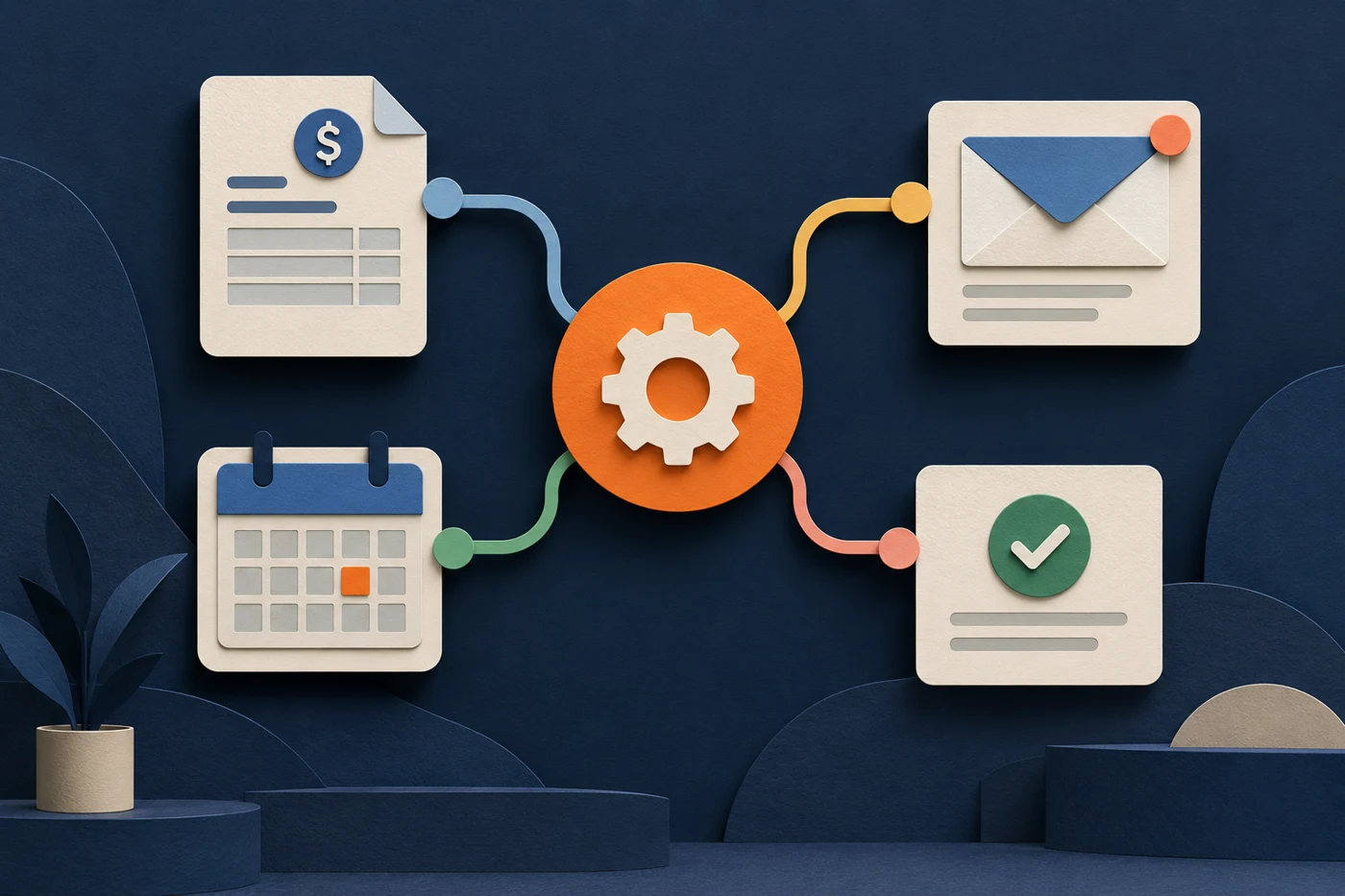
Which business workflow should we automate with AI first?
Choose a repeated task with bounded inputs, a measurable outcome and an easy review path. Classifying requests or drafting an internal summary can be useful pilots. Keep sensitive actions under human approval and compare total handling time, including review, with the current process.
Explore AI Integration & Custom AI Solutions for help with this work.
A practical AI integration guide for San Diego businesses: choose a workflow, connect existing tools, measure results and keep people in control.
Start with a repeatable task, not a chatbot purchase
AI integration connects a model to the information and tools used in a business process. That might mean classifying incoming service requests, drafting a response from approved guidance or extracting fields from a document for staff review. The useful question is not whether your company needs AI. It is which task can be improved without making errors harder to detect.
For a small business in San Diego, a sensible first workflow is frequent, bounded and easy to review. Drafting an internal summary is usually easier to pilot than giving an assistant permission to send commitments to customers. Mytek Pros offers AI integration and custom AI solutions that connect to existing business systems.
Decide whether AI is necessary
If a task follows stable rules, ordinary automation may be simpler and more predictable. Moving an approved record from one system to another does not necessarily need a language model. AI becomes more useful when inputs vary: free-text requests, differently formatted documents or questions phrased in several ways. Keep deterministic calculations and permission decisions in application code.
A service-request pilot could ask AI to suggest a category and draft a summary, while software checks required fields and routes the record according to approved rules. A staff member can confirm ambiguous cases. This separates a probabilistic suggestion from the final action and gives your team a clear way to handle exceptions.
Map the data before connecting tools
List the systems involved, the fields the workflow needs and who is allowed to see them. A model does not need an entire customer record to categorize a short description. Minimize the data sent, select an appropriate service configuration and review retention and access arrangements before using production information.
Integration design also includes operational details: API rate limits, retries, duplicate prevention and what happens if the model or destination system is unavailable. Give each run an identifier so a failed step can be traced without logging unnecessary sensitive content. Keep a conventional manual path available while the pilot is being evaluated.
Measure quality and cost together
Build a test set from representative, appropriately sanitized examples. Include straightforward requests, ambiguous wording, missing information and requests outside the intended scope. Measure correct classifications or useful drafts, the amount of human editing required, completion time and the cost of running the workflow. A fluent answer is not evidence that the task was completed correctly.
Define the acceptance threshold before the demonstration. For instance, your team might require every draft to remain unapproved until a staff member reviews it, and every uncertain request to enter a manual queue. Track whether the pilot actually reduces total handling time once review and correction are counted. Avoid promising a fixed percentage saving without evidence from your own operation.
Use a pilot to decide what should scale
NIST’s AI Risk Management Framework offers a voluntary structure for managing AI risks; it is not a certification that makes an application safe. A practical business pilot still needs a named owner, defined limits, monitoring and a way to stop the workflow. Review results after changes to the model, prompts or connected data because earlier tests may no longer represent the deployed behavior.
Discuss an AI integration pilot with Mytek Pros if your team has a repeatable workflow and a clear outcome to measure. If the main challenge is finding answers in internal documents, our private AI knowledge assistant guide explains a different architecture and its access-control requirements.