
Mytek Pros delivers end-to-end IT services, managed security, and low-voltage design/build for businesses across San Diego County and California.
Loading
Mytek Pros delivers end-to-end IT services, managed security, and low-voltage design/build for businesses across San Diego County and California.

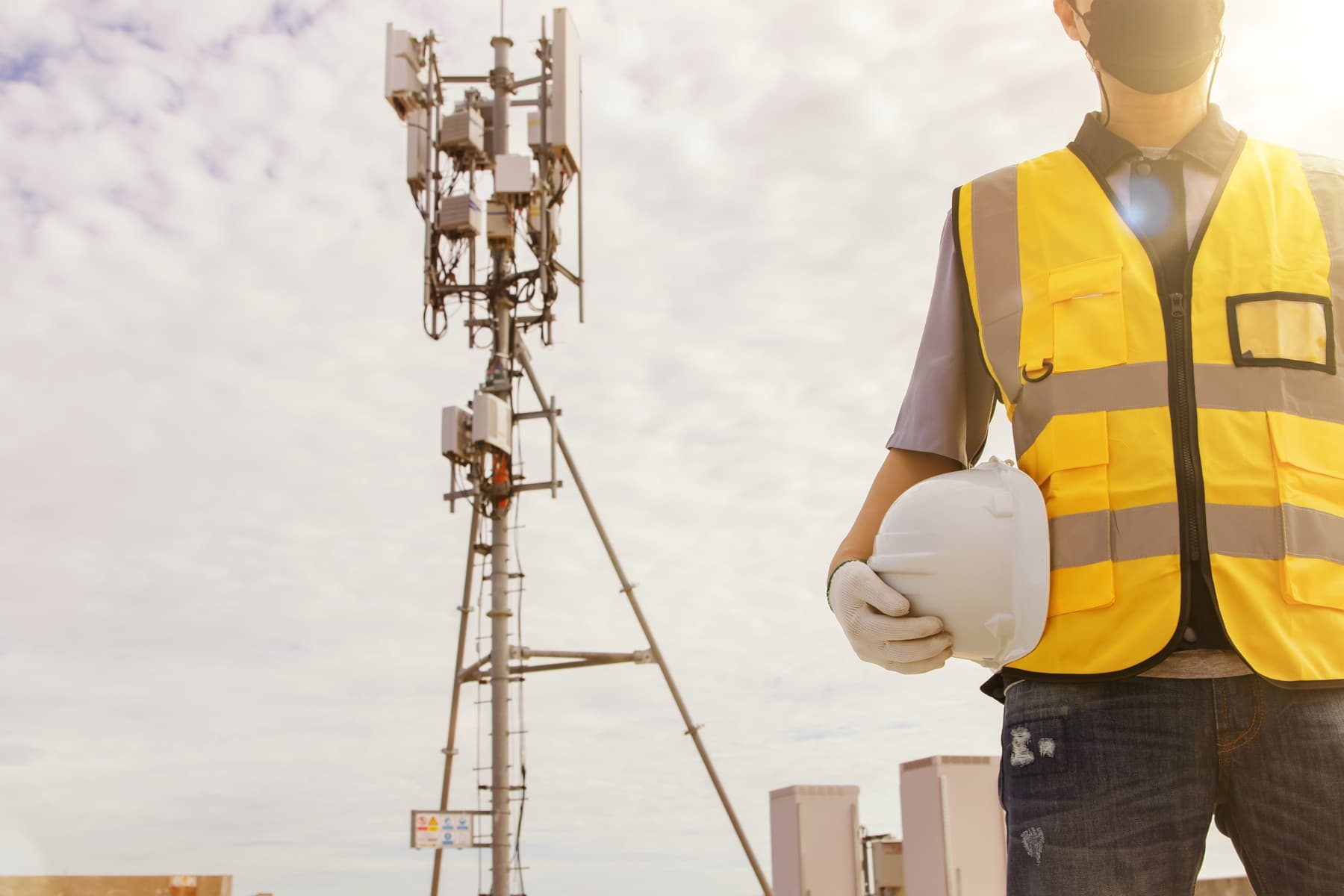
A distributed antenna system (DAS) and an emergency responder radio coverage system (ERRCS) solve two related but distinct problems inside modern buildings. Thick concrete, low-E glass, metal decking, and underground parking garages all block outside radio frequency signals, leaving dead zones where cell phones drop calls and, far more critically, where fire department and police radios go silent. An ERRCS -- also called an ERCES, or emergency responder communication enhancement system -- is a life-safety system built around a bi-directional amplifier (BDA) that captures the public safety radio frequencies used by local fire and police agencies, boosts them, and rebroadcasts them through a network of in-building antennas so first responders have reliable two-way radio communication on every floor, in every stairwell, and in every parking level during an emergency. A commercial cell phone signal booster or in-building cellular DAS, by contrast, is built to improve everyday voice and data coverage for tenants, guests, and employees, and increasingly needs to support 5G in-building network design alongside legacy LTE. Many projects need both systems, and both are governed by code: ERRCS installation in California is dictated by California Fire Code Section 510, which references NFPA 1225 and, as of January 1, 2026, the newly adopted 2025 edition of NFPA 72 for design and monitoring. Every Authority Having Jurisdiction -- San Diego Fire-Rescue, San Diego County, Orange County Fire Authority, LA County or LA City Fire, Riverside County Fire, or San Bernardino County Fire -- requires a minimum of 95 percent floor area public safety radio coverage on every level, formal acceptance testing witnessed by the fire authority, and a signed report before a certificate of occupancy is issued.
2026 is a pivotal year for this trade. California has adopted the 2025 edition of NFPA 72, and Section 14.4.10.1 now requires that ERCES supervisory signals -- active RF-emitter failure, loss of AC power, battery charger failure, battery depletion, and signal oscillation -- be monitored and annunciated through the building's fire alarm control panel (FACP), not just through a stand-alone BDA panel. That single change is triggering a wave of retrofit and upgrade demand: buildings with an existing BDA/DAS system installed under the older NFPA 72 or NFPA 1225 framework now need integration work to stay compliant, and CFC 510.6.1 requires annual testing and recertification regardless of a building's age. If your facility has never had its ERRCS tested against the current code, or if you're not sure whether your fire alarm panel is receiving supervisory signals from your BDA, that gap is exactly the kind of finding that surfaces during an annual inspection or, worse, during a real emergency.
Mytek Pros, Inc. designs and builds DAS and ERRCS systems as a licensed California low-voltage contractor (License #1116987) with DIR public-works registration (PW-LR-1001158430), BICSI-certified and DBE/DVBE/MBE-certified, serving San Diego and Carlsbad as home base and extending across San Diego County, Orange County, Los Angeles County, Riverside County, and San Bernardino County. Our design-build process starts with an RF site survey to measure existing public safety and cellular coverage floor by floor, including underground parking garages and stairwells that are frequently the weakest links. From there we engineer the BDA and antenna layout to hit the 95 percent floor area coverage requirement, choosing between an active DAS (fiber-fed remote units, better suited to large or multi-building campuses) and a passive DAS (coax-and-antenna distribution, often more cost-effective for a single mid-rise) based on the building's footprint, RF environment, and budget. We handle the full lifecycle: permitting and AHJ coordination, installation, acceptance testing with the local fire authority, and the ongoing annual testing and recertification that CFC 510.6.1 requires to keep the system's certificate current.
This work matters just as much for existing buildings as for new construction. Multifamily housing, affordable housing developments, senior living communities, hospitals, schools, and commercial office buildings across California commonly trigger ERRCS requirements once they cross roughly 50,000 square feet or add a third story or subterranean parking, and HCD-funded affordable housing projects face the same fire code obligations as market-rate developments. Property owners and facility managers, not just new-construction general contractors, are increasingly the ones responsible for budgeting DAS and ERRCS work, particularly as neutral-host and landlord-funded in-building wireless models become more common while carriers pull back capital spending on mid-size buildings. Whether you're a developer who needs DAS and ERRCS designed into a new construction project before final inspection, or a building owner who just learned your BDA system predates the 2025 NFPA 72 monitoring requirement, Mytek Pros brings the licensing, the field experience, and the AHJ relationships across Southern California to get the system designed, installed, tested, and recertified correctly the first time.
Because we hold a C-7 low voltage license and work daily with fire alarm and life-safety integration, we're equipped to make sure your ERRCS supervisory signals are properly wired into the FACP rather than left as an isolated system -- the exact gap the 2026 code update is designed to close. We also bring a forward-looking eye to the technology itself: as buildings adopt 5G and Wi-Fi 7 hybrid DAS designs and as AI-assisted RF monitoring tools mature, we design systems with the headroom to take advantage of smarter, more automated fault detection rather than locking clients into hardware that's obsolete in five years. From a single-building BDA retrofit to a full design-build DAS and ERRCS rollout for a multifamily or senior living portfolio, Mytek Pros is a single point of accountability -- licensed, certified, and local to Carlsbad and San Diego County.
A well-run DAS/ERRCS project follows a clear sequence, and knowing the steps helps building owners and developers set realistic timelines. Mytek Pros starts with an RF site survey, testing signal strength floor-by-floor to map dead zones in stairwells, basements, parking structures, and elevator shafts, and to assess how construction materials like reinforced concrete, low-E glass, and steel framing attenuate signal. Survey data feeds a stamped engineering design covering antenna placement, cable and fiber routing, and BDA (bi-directional amplifier) sizing. Once the design clears plan check with the local fire marshal or AHJ, our crews install the donor antenna, head-end equipment, and interior antenna network, then commission the system using grid-based testing (commonly 20-by-20-foot zones) before the fire marshal or designee witnesses the final acceptance test required to release occupancy.
Several situations should prompt a building owner or developer to have their property assessed for ERRCS, even outside of new construction. Multifamily and affordable housing owners in particular should treat any of these as a trigger to schedule an assessment before it becomes a compliance emergency during an inspection or financing review.
California ERRCS requirements are not one-size-fits-all: each Authority Having Jurisdiction (AHJ), city fire department, or county fire authority publishes its own standard, and the details vary. In Mytek Pros' home market, the City of San Diego enforces SDFD Standard C-1, which requires digital P25 bit-stream signal metrics (SINR/SNR and bit error rate thresholds) rather than analog-only readings, and annual test reports must be filed through the Compliance Engine portal. San Diego County unincorporated areas fall under a separate County Fire Authority standard, while Carlsbad, Oceanside, Vista, San Marcos, and Escondido each have their own city fire department guidelines even though dispatch is coordinated regionally. Elsewhere in the state, Los Angeles, Burbank, Alhambra, Orange County, Santa Clara County, Palo Alto, and San Francisco all maintain their own ERRCS standards and submittal processes. Because Mytek Pros serves projects across all of California, we verify the specific AHJ requirements for each project's jurisdiction rather than assuming a single statewide rule applies.
ERRCS and DAS technology and compliance obligations continue to evolve heading into 2026. The 2025 California Fire Code (based on the 2024 IFC) took effect January 1, 2026, though some AHJs, including San Diego, still reference 2022-cycle code language in their current standards, so verifying which code edition applies to a given jurisdiction matters. NFPA 72's 2025 edition also added a mandatory cybersecurity chapter that places internet-connected, remotely monitored fire alarm and BDA/DAS equipment under its highest security tier, which can require alignment with recognized cybersecurity frameworks. Some AHJs, such as Burbank, now explicitly require that BDAs be equipped so the FCC license holder or its designee can remotely monitor and control the unit on an ongoing basis, not just at installation. Mytek Pros also sees more developers combining public-safety ERRCS with commercial cellular DAS in a single install, and building in extra conduit and fiber capacity up front, to avoid reopening walls for future upgrades.