
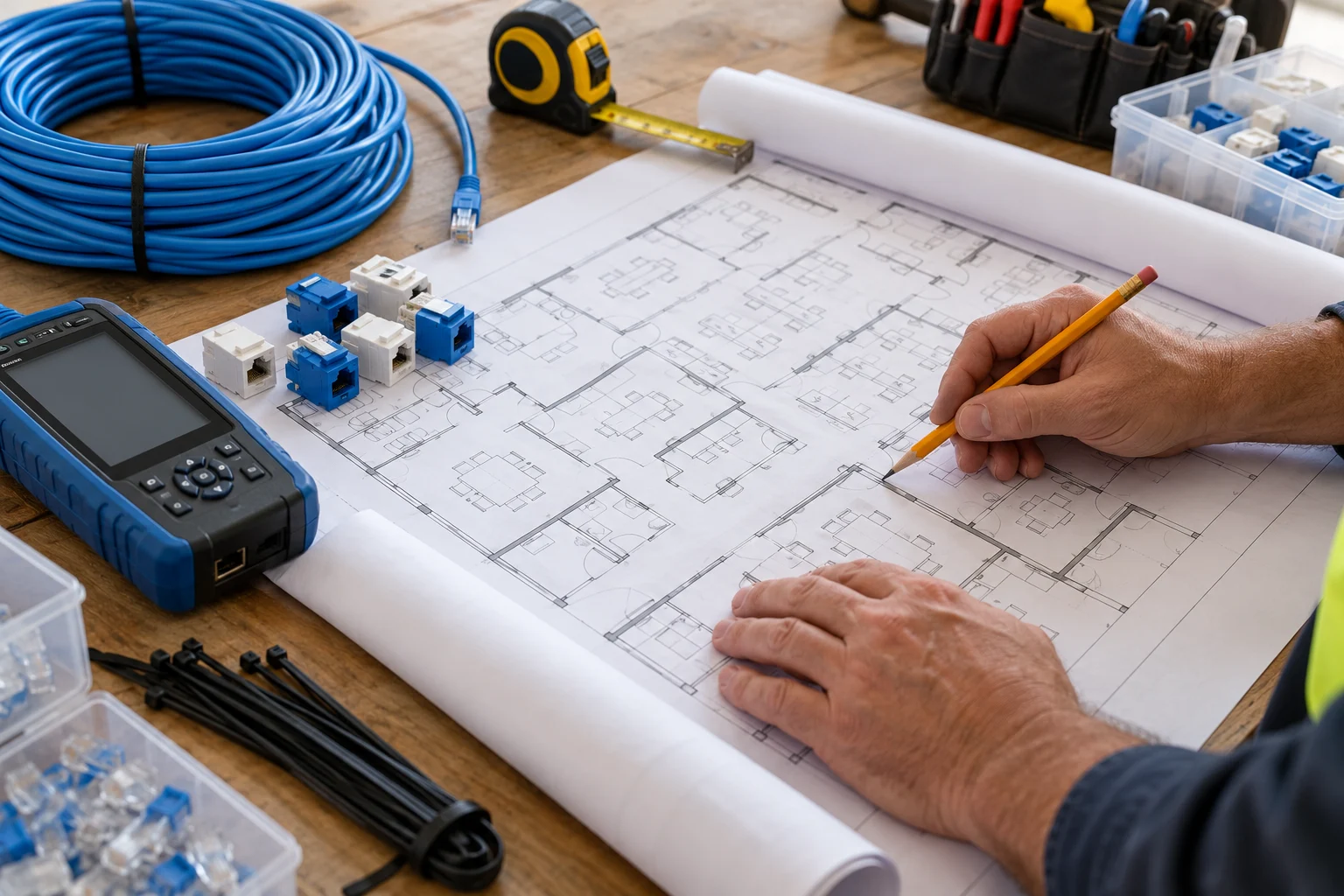
How much does structured cabling cost in San Diego? The answer depends on the actual installation: how many connections you need, how far they run, which cable system is specified and how easily installers can reach the route. A simple office buildout and an occupied-building retrofit can have very different labor requirements even when their outlet counts match.
This guide explains how to prepare a useful budget and compare contractor estimates. It does not publish a generic per-drop price: without a defined site and scope, that number could leave out the work that most affects your project. Mytek Pros provides project-specific estimates after reviewing requirements and site conditions.
Define what a network drop includes
Before comparing cost per drop, ask how each contractor defines a drop. Does the line item include the full cable run, both terminations, faceplate, labeling, testing and documentation? Are patch panels, patch cords, cabinets and access equipment included or separate? Two estimates using the same quantity can cover different deliverables.
Count connections from the floor plan and intended equipment: workstations, wireless access points, printers, cameras and other approved devices. Confirm spare capacity deliberately. Adding arbitrary extra outlets everywhere is not the same as planning for realistic expansion. Keep active network equipment separate from passive cabling unless the proposal explicitly bundles both.
Cable routes and building access drive labor
Straightforward accessible ceiling routes generally require different work from concealed pathways, congested risers or connections between buildings. Route length, ceiling type, working height and available conduit affect installation effort. An occupied suite may also require phased access, protection of furniture and coordination around staff.
In San Diego commercial properties, ask who arranges landlord approval, communications-room access and any required building coordination. A proposal should state assumptions about access hours, pathway availability, cleanup and penetrations. Resolve those questions before treating a budget allowance as a fixed project price.
Choose Cat6, Cat6A or fiber for the application
Cable category should follow the intended network, device requirements, distances and installation conditions. Ask the designer to explain why Cat6, Cat6A or fiber fits the project, including termination equipment and pathway implications. A more expensive cable label alone does not guarantee a better result for your specific use.
Longer routes and connections between buildings deserve particular review rather than simply extending copper indefinitely. Ask for a documented design and testing scope appropriate to the selected system. For a broader look at the installation process, review structured cabling services.
Separate cabling, equipment and additional construction
Request separate line items or clearly defined allowances for cabling, racks, patch panels, network switches, access points and configuration. Identify any conduit, wall repair, firestopping, electrical work or other coordination included in the quote. Do not assume related trades are included because a proposal says network installation.
For an office relocation, timing can matter as much as material selection. Finishing cabling before furniture arrives may simplify access, while late changes can require return visits. Coordinate the schedule with your office IT relocation plan, carrier appointment and destination readiness.
Include testing and handover in the comparison
Ask which tests are included and what results you will receive. Basic continuity checks and standards-based certification are different scopes. Fluke Networks describes cabling certification and the tools used to evaluate installed cabling. The appropriate acceptance method should be specified before installation, together with responsibility for resolving failed links.
A useful handover connects labeled outlets to labeled panel ports and includes the agreed test records and location documentation. That makes later troubleshooting and additions easier. Compare warranties and exclusions in writing, including whether equipment, cabling materials and installation labor have different terms.
What to send for a San Diego cabling estimate
Prepare the site address, floor plan, approximate outlet count, device locations and preferred schedule. Describe known ceiling or pathway constraints, existing cabinets and any requirement to work around an occupied business. If you are unsure about quantity, request help developing the scope rather than guessing a final drop count.
Ask each bidder to use the same assumptions and list exclusions. For an early budget, request an allowance with its conditions; for a firmer proposal, arrange a site review. Mytek Pros is based in Carlsbad and serves San Diego businesses with IT and low-voltage solutions. Request a structured cabling assessment to discuss a written scope and project-specific estimate.