

AI-Powered Video Surveillance: Separating Real Capability From Marketing Hype
Walk into almost any security equipment showroom or scroll any camera manufacturer's 2026 product page and the phrase "AI-powered" appears on nearly everything, from a $60 doorbell camera to a six-figure enterprise video management platform. That ubiquity is the problem. Somewhere between 2023 and now, "AI" quietly replaced "smart" as the default adjective vendors slap on products that haven't meaningfully changed, while a smaller set of genuinely capable analytics platforms emerged that can do something legacy motion detection never could: reliably tell the difference between a person, a vehicle, an animal, and a shadow, and surface only the events that actually warrant a human's attention. Property owners evaluating surveillance upgrades in 2026 are being asked to pay an AI premium across the board, but only a fraction of that spend is buying real capability. Knowing which is which has become a genuinely expensive question to get wrong.
The improvement in legitimate AI video analytics over the past two to three years is real and measurable, not marketing spin. Commercial-grade platforms from established manufacturers have demonstrated false-alarm reduction rates in the 70 to 90 percent range compared to legacy motion-detection systems, according to recent industry reporting on professionally installed monitoring systems. The mechanism is straightforward: instead of triggering on any pixel change, whether it's a person, a raccoon, a moving tree branch, or headlights sweeping across a parking lot at 2 a.m., modern analytics engines run object classification models that distinguish those categories with high confidence before ever generating an alert. That single capability, correctly implemented, is the difference between a system that cries wolf dozens of times a night and one that a property manager or monitoring center actually trusts enough to act on. Some providers report that pairing AI pre-filtering with remote video monitoring drives false-alarm rates to nearly zero, which is the outcome that actually changes staffing and response economics rather than just adding a feature checkbox.
But "AI-powered" on a spec sheet says nothing about which category of system you're buying, and that's exactly where the market has gotten murky. A camera that runs basic on-device motion detection with a pixel-change threshold, then labels that same feature "AI Smart Detection" in its marketing copy, is not doing anything a $150 consumer camera didn't do in 2018. Genuine analytics require real object classification models, usually running either on a dedicated edge chip inside the camera or on a VMS server processing the stream, and industry data on 2026 deployments shows edge processing now powers roughly 42 percent of enterprise camera installs specifically because pushing inference to the device reduces bandwidth and latency. If a vendor can't explain whether their detection runs on-device or in the cloud, what training data or model it uses, and what its actual false-positive rate has measured out to be in the field, you're likely looking at rebadged motion detection wearing an AI label, not a system that will change how many hours of live footage someone needs to sit and watch.
The tell that separates real capability from hype is usually specificity, not confidence. Ask a vendor to define exactly what their system alerts on, and a legitimate analytics platform will answer with concrete categories: person detection with loitering-time thresholds, vehicle classification distinguishing cars from trucks from delivery vans, line-crossing and zone-intrusion rules tied to specific camera coordinates, and often behavioral flags like a person moving against normal foot-traffic patterns or lingering near a specific entry point past a configured duration. A system running dressed-up motion detection will describe its capability in vaguer terms, things like "intelligent alerts" or "smart notifications," without being able to name the underlying detection categories or give you a real-world false-positive rate from a comparable deployment. Property owners evaluating quotes should ask providers directly for that specificity, because the gap between the two categories of system shows up in the contract price long before it shows up in performance.
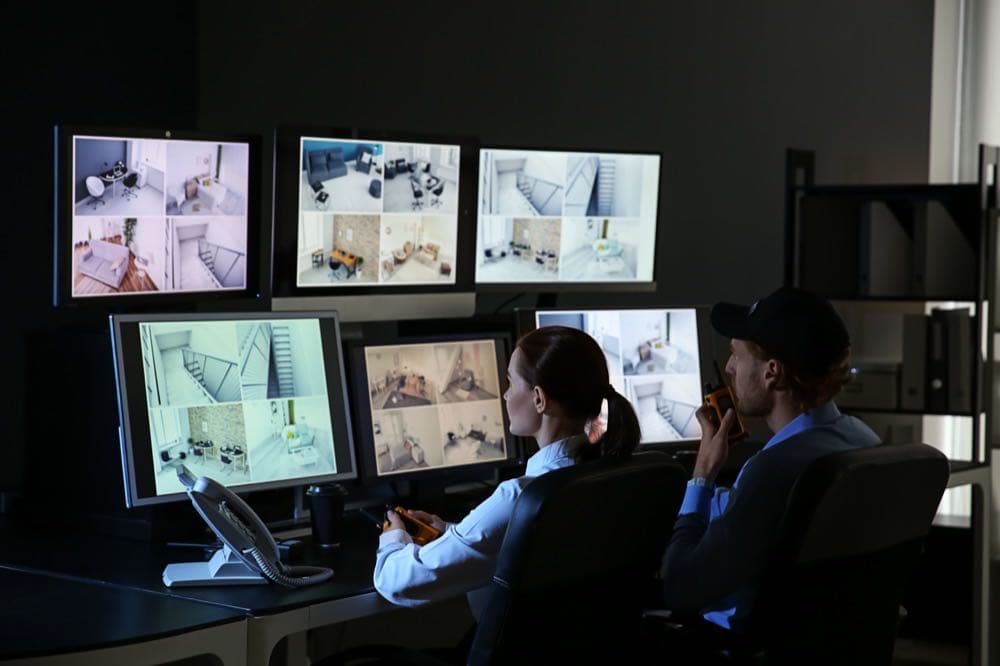
Deployment reality matters just as much as the underlying technology, and this is where even genuinely good analytics platforms can underdeliver if installed carelessly. Recent industry analysis on 2026 surveillance trends flags visual noise, low light, backlighting, and fog as the primary causes of AI detection failure in the field, and notes that a proper tuning period of several weeks is typically required to calibrate alert thresholds for a specific site's actual conditions before false positives drop to acceptable levels. A parking structure with harsh shadow lines at sunset, a loading dock with headlights sweeping the frame every few minutes, or a courtyard with heavy tree cover will all defeat an improperly tuned analytics system regardless of how sophisticated its underlying model is. This is precisely why camera placement, lens selection, and lighting conditions still matter as much in an AI-analytics deployment as they did in the motion-detection era — the smartest algorithm in the world can't compensate for a camera pointed into direct afternoon sun or mounted too far from the zone it's supposed to monitor.
The market's growth trajectory tells its own story about how much money is chasing this distinction. The video surveillance as a service (VSaaS) market is projected to reach somewhere in the $6 to $8 billion range globally in 2026, growing at a compound annual rate reported between roughly 15 and 18.5 percent, with AI-ready subscription tiers growing even faster than standard packages as analytics increasingly get bundled into mainstream security budgets rather than sold as a premium add-on. Recent industry data also puts facial recognition or object-tracking capability in roughly 45 percent of new commercial camera deployments. That volume of spend is exactly why the labeling gap matters financially: property owners who can't distinguish a real analytics platform from a relabeled motion sensor are, in aggregate, paying a premium for a feature set that may or may not exist behind the marketing language on the box.
For multifamily and affordable housing properties specifically, the practical payoff of real AI analytics is workforce economics, not just alert accuracy. A 138-unit or 200-unit property running a legacy motion-detection system typically needs either an on-site guard reviewing monitors or a remote monitoring contract sized around the assumption that most alerts require human eyes. A property running genuine analytics, correctly tuned, can cut that reviewed-alert volume dramatically, because the system itself has already filtered out the wind-blown debris, the maintenance staff doing rounds, and the resident's dog in the courtyard, surfacing only the events that match a defined risk pattern. That shift changes the conversation with a monitoring vendor from "how many cameras" to "how many hours of human attention does this system actually require," which is a materially different and usually lower cost basis once the system is properly deployed and tuned — the same operational logic that makes cloud-based multi-site security operations viable for portfolio owners managing several properties from a single dashboard instead of staffing each site separately.
Integration is the other place where the real-versus-hype distinction plays out in dollars and cents. A genuinely capable analytics platform is only as useful as the access control, alarm, and building systems it can talk to — a person-detection alert that can automatically lock down a specific door or trigger a notification to a specific on-call staff member is worth far more than the same alert sitting unread in a dashboard nobody checks after hours. This is the exact argument for unified security platforms over siloed camera, access, and alarm systems: the analytics engine's value compounds when it's wired into the rest of a property's security stack rather than operating as an island. Owners evaluating a camera upgrade in isolation, without asking how it integrates with existing door access or fire alarm systems, are likely to end up with exactly the kind of siloed deployment that limits what even good AI analytics can accomplish operationally.
Sizing the system correctly is where a lot of the premium-versus-value question gets decided before a single camera is ever mounted. Coverage gaps force property owners to either accept blind spots or add extra cameras to compensate, and either choice affects how well any analytics platform, real or rebadged, can actually perform — an analytics engine can't classify what a camera never captured in usable resolution. Before comparing AI feature lists across vendor quotes, it's worth running the numbers on how many cameras a given property actually needs to eliminate blind spots at the resolution analytics requires, which is exactly the calculation Mytek Pros built its free security camera coverage calculator to handle — entering square footage, entry points, and parking areas produces a realistic camera count and placement plan before a vendor conversation even starts, so the AI-versus-hype question gets evaluated against a properly scoped system rather than an undersized one.
None of this evaluation work happens in a vacuum from the rest of a property's security posture, either. As camera systems and access control increasingly run on the same IP network as everything else in a building, a compromised or poorly configured "smart" camera becomes an IT security problem, not just a physical security one — a pattern explored in more depth in our piece on cyber-physical convergence between cameras, access control, and IT security. Real AI analytics platforms generally handle this better than rebadged motion-detection systems because they're built by manufacturers investing in ongoing firmware security and cloud infrastructure, while cheaper AI-labeled hardware often ships with weaker default security postures and less frequent patching, another reason the cheapest "AI" quote in a bid packet deserves the most scrutiny, not the least.
This is exactly the evaluation Mytek Pros runs for every client considering a surveillance upgrade or new build: a straight answer on whether a proposed system's analytics are real object-classification capability or relabeled motion detection, an honest tuning-period expectation instead of a promise of instant zero-false-positive performance, and a design that accounts for lighting, camera placement, and network integration from day one rather than bolting analytics onto an undersized or poorly positioned camera plan. As a licensed California low-voltage contractor (License #1116987) with DIR public-works registration (PW-LR-1001158430, BICSI certified, DBE/DVBE/MBE certified) based in Carlsbad, Mytek Pros designs and installs surveillance and CCTV systems for businesses, multifamily housing, and affordable housing developers across California, specifying analytics platforms based on documented field performance rather than marketing copy. If you're evaluating a camera upgrade and can't get a straight answer from a vendor about what their AI actually does, contact Mytek Pros at (619) 353-5702 or inquire@mytekpros.com for an independent assessment before you sign.
Questions about design/build? Get in touch or explore our Design/Build services.