
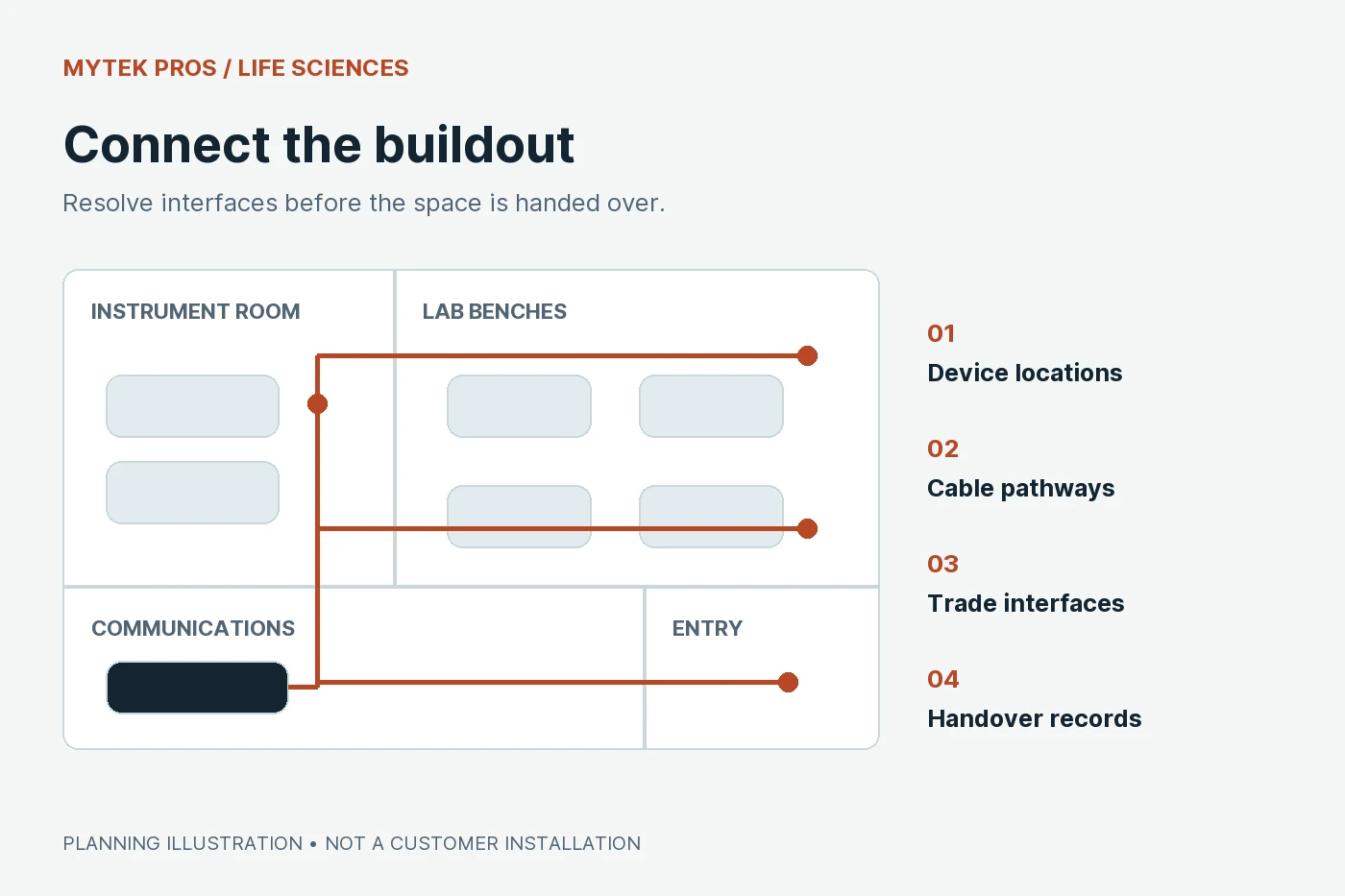
A laboratory buildout brings facilities, scientists, IT, quality and construction teams into the same project. Each can have a different definition of “ready.” A room may be complete while an instrument has no approved network connection, a camera has no retention policy, or a temperature alarm has no named responder. Treat technology as a coordinated work package from the start. This checklist is for owners, tenant representatives and project teams planning a new space, expansion or occupied-lab renovation.
Start with the room and equipment schedule
Create a room-by-room inventory with the intended use, equipment owner and planned occupancy. Include offices, shared benches, instrument rooms, storage, receiving areas and communications closets. Mark which information is approved and which is provisional. An early equipment schedule will change; a dated decision log makes those changes visible.
For each device, ask the manufacturer for connectivity, power, environmental and service-access requirements. Record whether it needs a wired connection, an approved wireless network or no network connection at all. Do not assume a laboratory instrument behaves like an office laptop. Identify vendor-supported operating systems and any restrictions on security agents or software updates.
Resolve interfaces before closing ceilings
Coordinate cable routes, sleeves, racks and outlet locations with the architectural and engineering drawings. Confirm access for future maintenance, available rack space, network-switch capacity and equipment power with the responsible trades. Assign responsibility for each penetration, firestopping detail and inspection rather than assuming it belongs to the cabling installer.
Build one interface list for doors, cameras, monitoring gateways and network equipment. For a controlled opening, identify who supplies the lock, reader, controller, power and door-position hardware. The design team and relevant authorities must resolve life-safety and egress requirements. Technology installation is only one part of that coordination.
Separate installation tests from operational acceptance
Agree on what each installer will test and what evidence will be delivered. Cabling work may include labeled endpoints, test reports and marked-up drawings. Network acceptance may include permitted connectivity and a recovery exercise. Security acceptance should use approved scenarios for credentials, camera views and event retrieval.
Commissioning evidence is useful, but it is not automatically a qualification or validation package. Where regulated operations require additional work, the client’s quality team defines the intended use, acceptance criteria and approvals. FDA’s process-validation guidance describes a lifecycle approach for applicable drug manufacturing; it is not a universal checklist for every research room.
Plan the transition into an occupied facility
Identify which systems must stay available during cutover. Agree on the work window, rollback trigger, responsible decision-maker and communication route. A new switch configuration can affect a monitoring gateway or instrument even when no physical cable moves. Confirm dependencies before scheduling changes.
Create a handover register containing drawings, asset identifiers, configurations, administrative ownership, support contacts, test results and open issues. Transfer credentials through an approved secure method, not in an emailed spreadsheet. Each unresolved item should have an owner and a target date.
Send a useful brief for pricing
Share the site address, project phase, floor plans, equipment list and construction schedule. Flag landlord requirements, restricted work hours and known shutdown constraints. Ask the proposal to distinguish installation, configuration, ongoing support and any client-led validation support. That makes competing scopes easier to compare.
For California projects outside Mytek’s core Southern California on-site region, confirm travel, local coordination and support arrangements early. A project-specific scope is more useful than a blanket promise that every system or location is covered. Review structured cabling services as one part of the complete buildout.
Discuss your facility
Explore technology infrastructure for California life sciences facilities or discuss your scope with Mytek Pros. Share your location, project phase and the systems involved. Keep research data, credentials and sensitive records out of the initial inquiry.