

ERRCS Compliance in California: What Property Owners Need to Know About CFC Section 510
California's growing skyline and increasingly airtight, energy-efficient buildings have created an unexpected public safety problem: firefighters and police officers can't always talk to each other once they step inside. That's the exact gap California Fire Code (CFC) Section 510 was written to close. Also known as ERRCS (Emergency Responder Radio Communication System) or ERCES, this code requires many new buildings to guarantee that public safety radios work reliably in stairwells, elevator lobbies, fire command centers, and basements — not just in open-air parking lots. For property owners, developers, and general contractors across California, ERRCS is no longer a niche fire-marshal footnote; it's a design and budget line item that can determine whether a project gets its Certificate of Occupancy on schedule.
CFC Section 510 is California's amended adoption of International Fire Code Section 510, and it doesn't operate alone — it works in tandem with NFPA 72 (which governs how the fire alarm control unit supervises the ERRCS) and NFPA 1225, the 2022 standard that consolidated the older NFPA 1221 and NFPA 1061 into a single reference for emergency services communications. Chapter 18 of NFPA 1225 specifically addresses in-building emergency responder communications enhancement systems: definitions, permitting expectations, system survivability, and acceptance testing protocols. Because adoption timing varies, some California AHJs still cite NFPA 1221 in their local bulletins — a detail worth confirming with your fire marshal rather than assuming based on the newest published standard.
California's code cycle is also mid-transition. The 2025 California Fire Code, Title 24 Part 9 (based on the 2024 IFC), was published July 1, 2025, with a statewide effective date of January 1, 2026, and a subsequent errata release. The existing 2022 amendments to Chapter 9 — which houses Section 510 — are being carried forward, renumbered, and reformatted to match the revised IFC structure. Practically, that means the substantive coverage requirements are staying largely intact, but section numbers and cross-references may shift. Because every city and county must locally adopt (and can further amend) the state code, many California jurisdictions may still be operating under 2022 CFC language well into the 2026 transition period. Always verify current section numbers against your specific AHJ's locally adopted edition before finalizing a design.
The technical bar for compliance is specific and measurable, not subjective. A building demonstrates acceptable coverage when signal strength meets threshold in 95 percent of general floor areas and 99 percent of designated critical areas — a category that explicitly includes fire command centers, fire pump rooms, exit stairs and passageways, elevator lobbies, standpipe cabinets, and sprinkler sectional valve rooms. The code sets a minimum inbound signal level of -95 dBm, sufficient to deliver a Delivered Audio Quality (DAQ) of 3.0 or an equivalent signal-to-interference-plus-noise ratio for digital systems. Any amplification equipment — bi-directional amplifiers (BDAs) and DAS components — must be listed to UL 2524. Acceptance testing itself is refreshingly concrete: two portable radios, one within 10 feet of an antenna and one at the farthest point of coverage, keyed up simultaneously on different frequencies to verify audio clarity.
Not every building triggers ERRCS obligations, but the exemptions are narrower than most owners assume. Under local guidelines such as San Diego County Fire Authority's CFA 505, ERRCS generally does not apply to Group R-3 occupancies (single-family homes, duplexes, townhomes), open parking structures with no subterranean levels, or buildings under 50,000 square feet with no subterranean portion. Los Angeles' local ordinance follows a similar 50,000-square-foot threshold with comparable carve-outs for wood-frame construction without basements. The catch: these thresholds and carve-outs vary by jurisdiction, and San Diego County alone has multiple overlapping AHJs — the County Fire Authority, the City of San Diego Fire Department, Carlsbad Fire Department, and various North County fire districts — each running its own plan-check process against the same state code baseline. A building that's exempt in one jurisdiction may not be in the next city over.
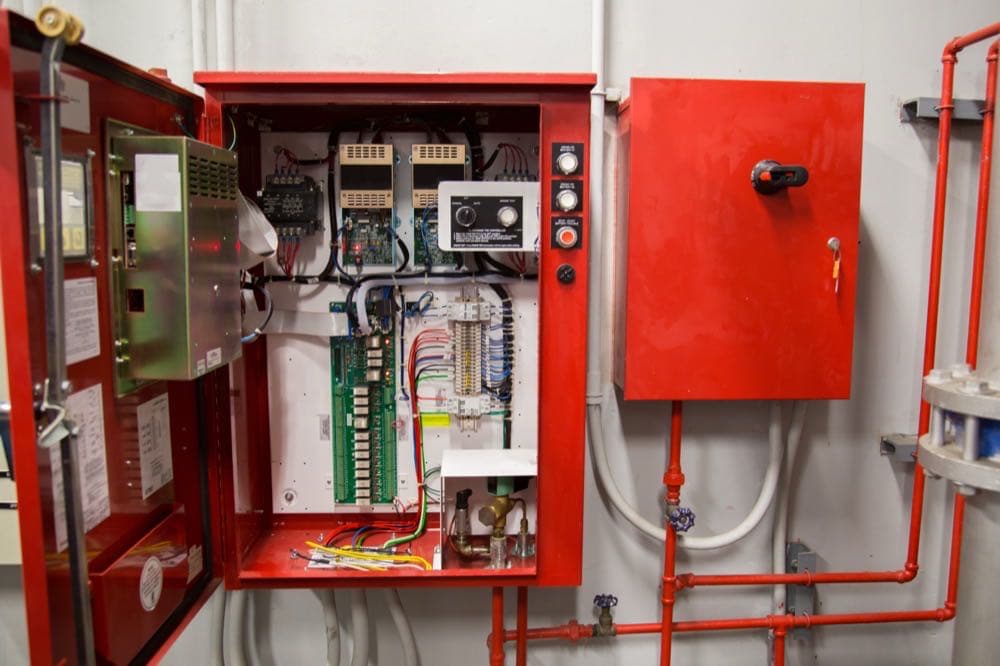
Multifamily and affordable housing developers should pay particularly close attention here, because the R-3 exemption only covers single-family homes, duplexes, and townhomes. Apartment buildings, condominiums, and senior or assisted living communities classified as R-1 or R-2 occupancies are not exempt and must comply with CFC 510 exactly like commercial buildings once they cross the local size or subterranean-level threshold. Subterranean parking — extremely common in dense multifamily and affordable housing projects trying to maximize unit count on limited lots — is one of the most frequent applicability triggers, regardless of overall square footage. No ERRCS carve-out exists for LIHTC or other affordable-housing funding sources; the code applies identically. Given that California's affordable housing production costs are already well-documented as high relative to other states, an unplanned late-stage ERRCS retrofit can be a painful surprise to a tight pro forma — one more reason to build coverage assessment into early plan check.
Ironically, the same green-building features California's energy code increasingly requires are a major reason new buildings fail ERRCS testing in the first place. Low-emissivity (low-E) glass, now standard for thermal performance in most new commercial and multifamily construction, contains a thin metallic-oxide coating that reflects and absorbs RF energy — causing signal loss measured at -24 dB to -40 dB, up to ten times worse than clear glass. Pair that glazing with modern concrete construction, which can attenuate signal by as much as 50 dB at higher frequencies on its own, and studies show combined coverage losses of 47 to 50 percent in higher-frequency bands compared to buildings without these materials. In short: the tighter and more energy-efficient the envelope, the more likely a new building is to fail its ERRCS grid test — making a distributed antenna system (DAS) or BDA a near-default requirement for new construction rather than an edge case.
Emergency power is its own compliance category. The general expectation under NFPA 1225/IFC 510 is at least 12 hours of operational battery backup (enough to actively amplify and transmit) and 24 hours of supervisory/monitoring power after a utility power failure — but many California AHJs require a full 24-hour operational battery bank rather than the 12-hour minimum, and some will accept a reduced battery bridge (as little as 2 hours) if a standby generator picks up the load automatically and carries its own 12- to 24-hour fuel supply. None of this is standardized statewide; it's AHJ-discretionary, which means the battery and generator sizing conversation needs to happen with your specific local fire marshal before equipment gets ordered, not after.
Passing the initial acceptance test isn't the finish line — annual testing is mandatory under CFC 510.6.1 (or its local equivalent), and retesting is required any time structural modifications could affect coverage, including renovations, added partition walls, or new low-E glazing installed during a tenant improvement. A proper annual test covers RF grid signal strength and DAQ measurements across all required coverage areas, two-way audio clarity checks, power supply and BDA/amplifier health verification, battery load testing to confirm runtime, and supervisory alarm simulation — all documented with RF grid maps, test logs, and tester certification. Many AHJs expect the tester to hold NICET certification through its dedicated in-building public safety communications program, developed jointly with the Safer Buildings Coalition. Skipping or failing annual testing risks compliance citations and, more importantly, means nobody finds out the system doesn't work until first responders actually need it during a real emergency.
There's a separate, federal layer of compliance that owners frequently overlook: FCC Part 90 rules governing signal boosters used in ERRCS/DAS installations. Class B boosters — the category most commonly deployed in commercial buildings — must be registered in the FCC's online signal booster database before operation, a free registration that's been required since November 1, 2014. Equipment must also carry a label warning that unauthorized operation can trigger penalties exceeding $100,000 per continuing violation, enforced by the FCC's Enforcement Bureau independent of any local fire code action. Power is also capped — effective radiated power limited to 5 watts on forward and return links for licensees operating above 150 MHz. Building owners assume their installer handled this, but it's worth confirming registration paperwork exists in the project file, since the liability sits with the licensee/building owner, not just the contractor.
Budgeting for ERRCS is where many projects get surprised late in design. Passive DAS systems typically run $0.30 to $0.70 per square foot, while active DAS ranges from roughly $2 to $10 per square foot depending on building size — smaller buildings under 50,000 square feet trend toward $2 to $4 per square foot, mid-size buildings toward $3 to $6, and large facilities toward $4 to $10. Multi-carrier active systems supporting commercial cellular alongside public safety push toward the higher end. Geography matters too: the same 100,000-square-foot building might cost roughly half in a lower-regulation market compared to dense, high-regulation California metros. Owners often miss two fire-code-driven cost adders in early estimates: fire-rated coaxial cable and a dedicated two-hour fire-rated equipment room for head-end/BDA equipment — both required by NFPA/IFC provisions and easy to underbudget if ERRCS isn't scoped until late in construction documents.
Because failing an ERRCS grid test means no Certificate of Occupancy — full stop — until the system is remediated and retested, this is a compliance issue with direct, quantifiable financial exposure: delayed tenant move-ins, delayed lease commencement, and extended construction loan carrying costs on multifamily and affordable housing deals where every month of delay compounds. Mytek Pros, Inc. is a licensed California low-voltage contractor (License #1116987) with DIR public-works registration (PW-LR-1001158430, BICSI certified, DBE/DVBE/MBE certified) based in Carlsbad and serving businesses, multifamily housing, and affordable housing developers throughout San Diego County and beyond. Our structured cabling and DAS/ERRCS design-build services are built around exactly the scenario described above: getting coverage assessment, BDA/DAS design, fire-rated infrastructure, and annual testing scheduled early enough that CFC Section 510 compliance is a planned line item, not a last-minute change order threatening your occupancy date. Contact us at (619) 353-5702 or inquire@mytekpros.com to get an ERRCS assessment scoped before your next plan check.
Questions about design/build? Get in touch or explore our Design/Build services.