

Biometric Door Access Control in 2026: What California's New Employee Privacy Rules Mean Before You Install a Fingerprint or Facial Reader
Property owners are adopting biometric door readers faster than at any point in the technology's history, driven by speed, hygiene, and a straightforward desire to stop dealing with lost, cloned, or shared key cards -- and they're doing it at the exact moment California quietly rewrote the rules for what that hardware means legally. New CPRA regulations that took effect January 1, 2026 extend full CCPA rights -- notice at collection, access, deletion, and opt-out -- to California employee data for the first time. That single change means a business enrolling staff fingerprints or face templates at a door reader now has live, active compliance obligations that most low-voltage buyers, and more than a few installers, have never had to think about before this year.
The legal hook is broader than most people assume. The CCPA, at Civil Code Section 1798.140(v), defines 'biometric information' expansively enough to explicitly include fingerprints, iris and retina scans, face and palm geometry, voice recordings, and even gait -- and classifies all of it as protected 'sensitive personal information.' That definition was never limited to online or digital biometrics; it covers physical door-access hardware just as directly as it covers a phone's face-unlock feature. Before this year, a business could reasonably argue that employee data enrolled for an internal access-control system sat outside CCPA's consumer-focused scope. The January 2026 regulatory change closes that gap -- an employee whose fingerprint template is sitting on your access-control server now has the same notice and deletion rights a customer would.
The financial exposure attached to getting this wrong is real and specific, not theoretical. The California Privacy Protection Agency's administrative fines currently run $2,663 per violation, or $7,988 per intentional violation (or any violation involving a consumer under 16) -- a roughly 6.5% CPI-driven increase from the prior $2,500/$7,500 caps that holds through 2026 and adjusts again in odd-numbered years. Separately, and more consequentially for a business with dozens or hundreds of enrolled employees, Civil Code Section 1798.150 gives California residents a private right of action for biometric data breaches, allowing $100-$750 in statutory damages per person, per incident -- damages that don't require proving actual harm occurred, only that a breach happened.
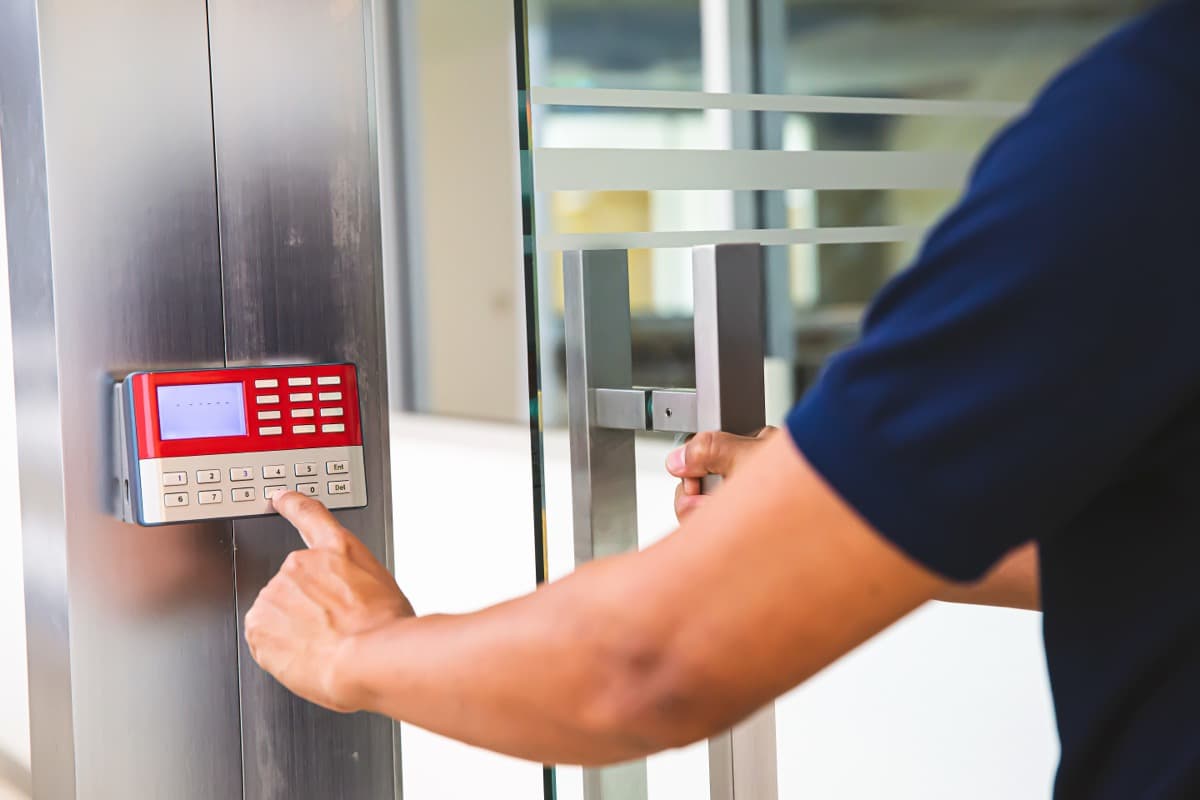
Illinois' Biometric Information Privacy Act (BIPA) is the closest real-world precedent for what unmanaged biometric access-control liability actually costs, and 2025 produced two settlements worth knowing about even though they happened outside California. Speedway LLC finalized a $12.1 million settlement on October 23, 2025, covering roughly 7,700 employees -- about $970 per person -- over finger-scan time clocks deployed without proper consent. Pret A Manger settled a materially smaller but structurally identical case for $677,450, covering about 797 employees at roughly $518 per person, for the same underlying violation: enrolling employee fingerprints at a device without the consent and retention-disclosure process the law required. California's statutory framework is different from BIPA in its mechanics, but the pattern that produced these settlements -- a biometric time clock or door reader deployed as a hardware decision with no privacy paperwork behind it -- is exactly the pattern California's 2026 employee-data rules now reach.
It's worth separating the compliance question from the technology question, because biometric reader accuracy has genuinely improved and shouldn't be judged on outdated assumptions or vendor marketing claims either way. NIST's Face Recognition Technology Evaluation (FRTE) is the closest thing the industry has to an independent benchmark, and as of April 2025, NEC's algorithm ranked as the world's most accurate, achieving a 0.07% false-negative error rate at a fixed 0.3% false-positive threshold on a 12-million-person dataset. That's real, independently verified evidence that top-tier facial recognition has gotten dramatically better -- though accuracy still varies widely by vendor and algorithm tier, which is exactly why the hardware selection and the compliance paperwork need to be evaluated together rather than treating one as a proxy for the other.
The market data reflects how fast this category is moving. The fingerprint access-control hardware market alone was valued at $3.04 billion in 2025 and is projected to reach $7.35 billion by 2035, a 10.6% compound annual growth rate, with North America holding the largest regional share at 32.8% in 2025, driven specifically by commercial, office, and enterprise deployment. The touchless and contactless access control market grew from an estimated $1.66 billion in 2024 to $1.79 billion in 2025, on a path toward roughly $3.58 billion by 2034, with hygiene and frictionless entry cited alongside biometrics and mobile credentials as the primary adoption drivers. Facial recognition specifically is the fastest-growing reader modality, representing an estimated 29.6% of the technology share in 2025 -- a real shift from card-only systems toward biometric and hybrid credential models in commercial buildings, not a niche or experimental category anymore.
One more requirement gets missed on a surprising number of California commercial retrofits: accessibility. Under the U.S. Access Board's ADA Standards, Chapter 3 (Operable Parts), biometric readers, card readers, and keypads must be mounted within a 15-to-48-inch unobstructed reach range (reduced to a 44-inch maximum if reaching over an obstruction deeper than 20 inches), with a minimum 30-by-48-inch clear floor space in front of the device. This is a federal accessibility requirement, not a California-specific one, but it applies to every biometric or card reader installed in a commercial building in the state, and it's routinely violated in retrofit installations where a reader gets mounted wherever the existing conduit happens to run rather than where the ADA standard actually requires it. A biometric deployment also needs a genuinely accessible fallback credential -- PIN, card, or mobile -- for anyone who can't or doesn't want to enroll a biometric template, both as an ADA matter and, increasingly, as a practical response to employee privacy preferences.
Mytek Pros designs and installs biometric and hybrid access-control systems as a licensed California low-voltage contractor (License #1116987) with DIR public-works registration (PW-LR-1001158430) and BICSI certification, based in Carlsbad and serving San Diego County and businesses throughout California -- and we build ADA-compliant mounting heights and an accessible fallback credential into the design from day one rather than retrofitting a fix after a complaint. Our Compliance Audits service reviews the technical and operational half of an existing or planned biometric deployment -- who has administrative access to enrolled templates, how retention is configured, what safeguards protect the access-control server -- as part of getting a system audit-ready; that's a technical review, not legal advice or a CCPA compliance certification, and we'll point you to counsel for the legal determination your specific deployment requires. If your property is evaluating fingerprint or facial-recognition door readers, contact Mytek Pros at (619) 353-5702 or inquire@mytekpros.com to talk through a system that's designed right, and compliant, from the first installed reader.
Questions about design/build? Get in touch or explore our Design/Build services.