

Touchless & Mobile Credential Access Control: Should Your Property Upgrade in 2026?
Ask any property manager in San Diego or Orange County what tenants and prospective renters are asking about during tours, and access control now comes up before amenities. A growing share of prospective residents ask whether they can get into the building with their phone before they ask about the gym or the pool. That shift didn't happen because key fobs stopped working -- it happened because everyone now carries a device capable of replacing them, and multifamily operators are discovering that residents expect the same tap-to-enter experience their apartment building offers that they already get at a hotel or a coworking space. The pressure isn't coming from a code requirement or an insurance mandate. It's coming from move-in day, from leasing tours, and from residents comparing your property to the one down the street that already switched.
The technology driving this shift is mature, not experimental. Mobile credentials use Bluetooth Low Energy (BLE), Near Field Communication (NFC), or both to let a smartphone or smartwatch communicate with a door reader, and most modern access control platforms now issue credentials the same way an email invite works -- a resident downloads an app, receives a digital key tied to their unit or workspace, and taps or waves their phone at the reader. Because the credential lives in a secure element on the device (the same hardware that protects Apple Pay or Google Wallet transactions), it is harder to clone than a standard proximity card, many of which still use 125 kHz low-frequency technology that a cheap handheld cloning tool can copy in seconds. For property owners still running unencrypted HID Prox or 26-bit Wiegand credentials, that vulnerability isn't hypothetical -- it's a documented, well-known weakness that mobile and encrypted smart-card credentials were built specifically to close.
Touchless is the other half of this trend, and the two get conflated even though they solve different problems. A touchless reader can still read a physical card or fob held near it rather than swiped through a slot, which matters in food service, healthcare-adjacent, and senior living settings where minimizing shared contact points remains a real infection-control consideration, not just a leftover pandemic habit. Layer mobile credentials on top of that same touchless reader and you get a system that supports phone, watch, card, and fob simultaneously -- which is exactly how most large multifamily portfolios are actually migrating, since forcing every resident onto a phone-only system on day one is unrealistic. Recent industry reporting on physical access control adoption consistently points to the same pattern: properties that support multiple credential types during a transition period see far higher tenant satisfaction scores than properties that force a hard cutover, because a subset of residents will always want a physical backup credential regardless of how good the app is.
The real-time connectivity piece is where this stops being a convenience upgrade and starts being a risk-management upgrade. Legacy standalone locksets and offline card systems require someone to physically walk to a control panel or a specific door to add or revoke a credential, and re-keying an entire building after a lost master key or a bad termination can run into the tens of thousands of dollars in hardware and labor. Cloud-managed mobile credential platforms let a property manager revoke a departed resident's or terminated employee's access from a phone in seconds, push a temporary credential to a vendor or maintenance tech for a four-hour window, and pull a full audit log of every door event across an entire multi-building portfolio without visiting a single site. For a property with any degree of turnover -- and multifamily turnover in California routinely runs 40-60% annually -- that difference compounds fast, and it's the same operational logic behind cloud-based security operations for multi-site portfolios, where centralizing management across properties turns a staffing problem into a dashboard.
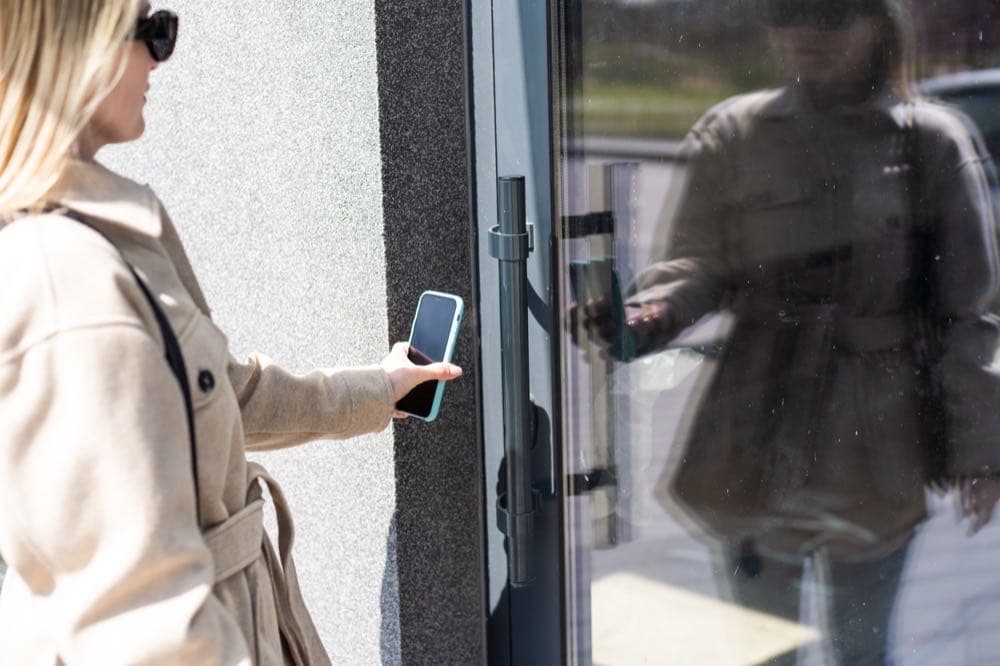
Cost is where property owners get the most confused, because mobile credential and touchless upgrades are frequently marketed as a simple software swap when they are, in most existing buildings, a hardware project. Readers built for 125 kHz prox cards generally cannot be firmware-upgraded into BLE/NFC-capable readers -- the antenna and radio hardware are different, so a genuine upgrade means replacing readers at every controlled opening, which on a mid-size property can mean 20 to 60 door positions. The credentials themselves are often cheaper on a per-user basis than physical fobs once you're past year one, since there's no plastic to reissue when someone loses a card, but the initial capital outlay for reader hardware, controller compatibility, and cabling verification is real and needs to be scoped against the building's existing low-voltage infrastructure before anyone commits to a rollout date.
This is also where the access control conversation increasingly overlaps with a building's broader network and camera infrastructure, and property owners who treat them as separate projects usually end up paying for the same trenching, conduit, or cable run twice. A door reader on a mobile credential platform is a networked IoT device that needs power and data to the door, ideally on a segmented VLAN away from resident WiFi and guest networks, and it needs to coordinate with video at the same openings so that an access event and a camera clip can be pulled together during an incident review. That convergence is exactly the shift covered in why cameras and access control are now an IT security problem -- a mobile credential rollout done without IT involvement tends to create exactly the kind of unmanaged, internet-facing device that shows up in a penetration test finding six months later.
Vendor lock-in is a second trap worth naming directly. Several of the mobile credential platforms marketed hardest to multifamily owners tie the property to a single manufacturer's cloud, a proprietary app residents must install, and per-door or per-credential licensing fees that scale with unit count indefinitely. Before signing a multi-year agreement, property owners should ask pointed questions about credential portability (can a resident's mobile key work if the property switches access platforms later), data residency (where is door-event and resident data actually stored), and whether the reader hardware supports open credential standards like OSDP rather than a single vendor's closed protocol. None of this is exotic due diligence -- it's the same category of vendor-risk question increasingly asked of any managed service provider, echoing the concerns raised around MSP supply chain risk when a vendor is breached or acquired, because an access control vendor holding resident PII and door-event logs is functionally a data processor for the property.
For affordable housing and senior living properties specifically, the calculus shifts again. Residents in these communities are less likely to universally own a smartphone capable of running a BLE credential app, and staff turnover in front-desk and maintenance roles means credential provisioning needs to be simple enough for a new hire to manage on day one without a training session. A hybrid rollout -- keeping card and fob support fully functional while adding mobile as an option, rather than a replacement -- tends to be the more defensible design in these settings, both operationally and from a fair-housing standpoint, since no resident should lose practical access to their home because they don't carry a particular phone. Before finalizing a design, it's worth reviewing camera coverage at the same doors being upgraded, since a reader replacement project is the cheapest point in a property's lifecycle to also close gaps in video coverage -- Mytek Pros' free security camera coverage calculator gives owners a fast way to check whether existing camera placement actually covers the entry points being retrofitted before crews are on site.
None of this needs to be a guess, and it shouldn't be scoped by whoever answers the phone at a card-access reseller. Mytek Pros designs and installs mobile-credential and touchless access control systems as a licensed California low-voltage contractor (License #1116987, DIR registration PW-LR-1001158430, BICSI certified, DBE/DVBE/MBE certified), which means the same team scoping your door hardware also handles the network segmentation, camera integration, and cabling behind it -- not a software vendor subcontracting the physical install to whoever's cheapest that month. Our door access system design and installation service covers everything from reader selection and OSDP-compliant controller wiring through credential provisioning and integration with existing camera and fire systems, sized correctly for multifamily, affordable housing, and commercial portfolios across Southern California. If residents or tenants are already asking when your property is getting phone-based entry, call (619) 353-5702 or email inquire@mytekpros.com and we'll walk the property with you before you sign anything with a vendor.
Questions about design/build? Get in touch or explore our Design/Build services.