
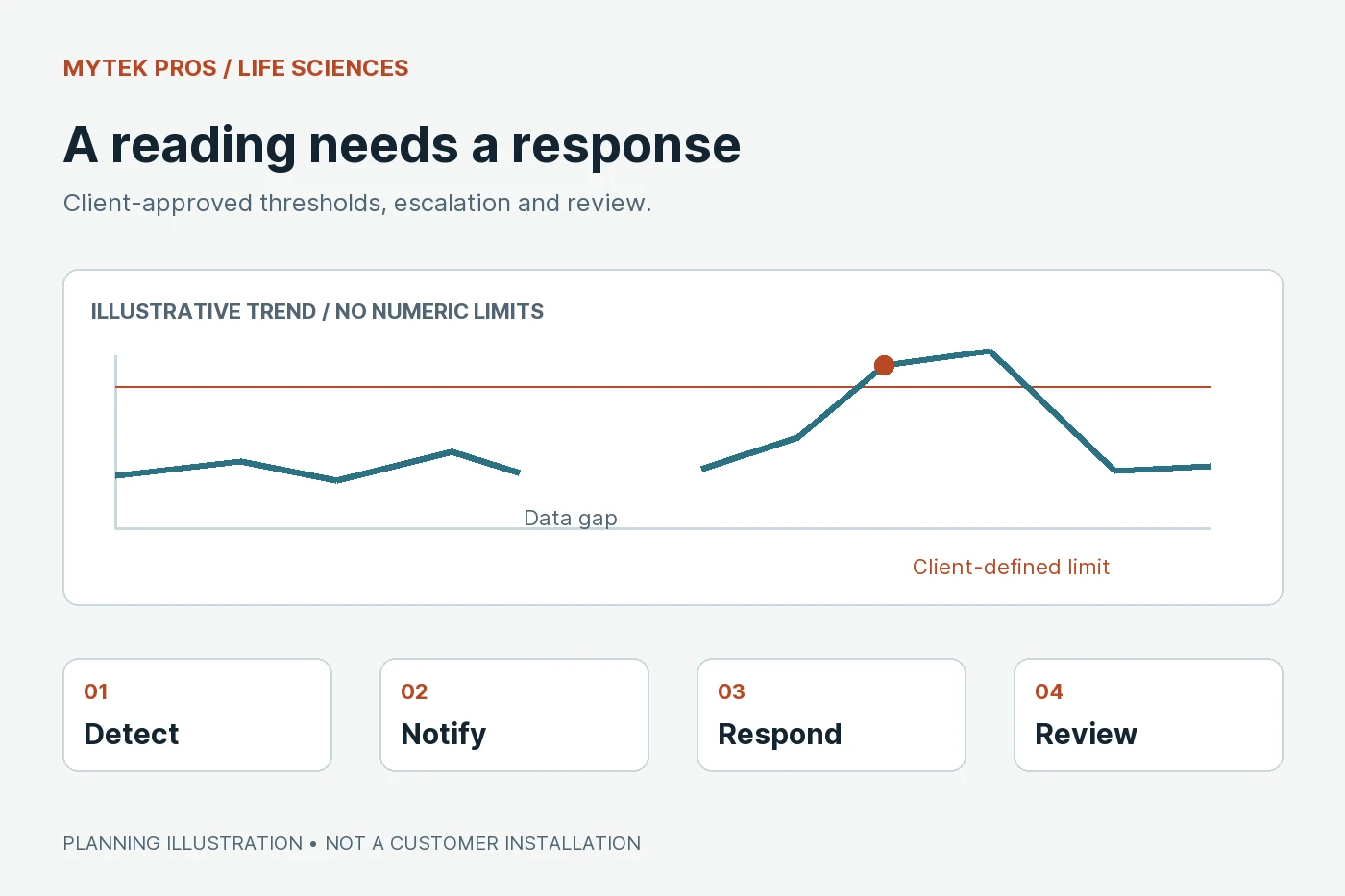
A temperature reading has limited value if nobody knows which equipment it belongs to, whether the sensor is suitable, or what happens when it crosses a limit. A monitoring project should connect measurement, communication and response. Start with the material or process being protected, then have the responsible laboratory or quality team define the monitoring requirement. There is no single temperature range or log-retention period that fits every laboratory.
Define the measurement before choosing the device
Identify the monitored asset, its purpose and the consequences of missing a change. A room sensor, a refrigerator probe and a freezer probe measure different conditions. Record the required range, accuracy, placement, sampling approach and acceptable gaps as approved by the responsible team. Do not select a sensor only because it connects to the network.
Confirm who specifies and performs calibration, maintenance and any mapping study. Applicable drug operations may bring requirements for automated equipment checks and records under 21 CFR 211.68. That does not turn a generic sensor installation into a validated monitoring system. The client determines applicability and approves the relevant procedures and acceptance evidence.
Trace the complete alarm path
Draw the path from sensor to gateway, network, monitoring platform and responder. Identify power and internet dependencies at each step. Ask what happens when the gateway stops communicating: an unchanged graph may represent missing data rather than stable conditions. Make loss of communication visible and agree how it is escalated.
Define primary and backup responders, acknowledgement expectations and after-hours coverage. Confirm the delivery channels available in the chosen platform and the client-approved escalation sequence. Distinguish a technical support call from an operational decision about affected samples or materials. Mytek’s infrastructure scope does not replace that decision-maker.
Test planned failures safely
Use a controlled test approved by the asset owner to demonstrate alarm delivery, acknowledgement and escalation. Test a communication interruption as well as a threshold event if the system and agreed procedure permit it. Do not expose live materials to an unsafe temperature simply to prove an alarm.
Record the test conditions, time, recipient and observed outcome. If an alarm reaches an inbox but the expected person cannot act, the workflow needs adjustment. Repeat relevant tests after configuration changes, staff changes or network maintenance as defined in the client’s procedures.
Make the log understandable later
A useful export identifies the sensor, asset, timestamps, time zone, measurement units and gaps. Preserve relevant configuration history and the context needed to interpret a reading. Record who changed thresholds or routing where the platform supports it. A screenshot of a chart is not necessarily a complete record of the event.
Have the records owner set access, review, retention and retrieval requirements. If the log is a required electronic record under an applicable FDA predicate rule, assess Part 11 within that defined scope. Do not assume every environmental log is automatically covered, or that a platform feature establishes compliance by itself.
Assign ownership at handover
Use a responsibilities list covering probes, gateways, batteries, network connectivity, platform subscriptions, alarm recipients and response decisions. Include the procedure for adding a new monitored asset and removing one from service. Export an authorized sample report and have the intended reviewer confirm it is usable.
A proposal should separate monitoring infrastructure, platform configuration and ongoing support from calibration, quality review and validation responsibilities. Ask for a supported integration and documented handover, with client-approved thresholds and response plans. Read the buildout planning checklist to coordinate monitoring before equipment arrives.
Discuss your facility
Explore technology infrastructure for California life sciences facilities or discuss your scope with Mytek Pros. Share your location, project phase and the systems involved. Keep research data, credentials and sensitive records out of the initial inquiry.